Archive for the ‘Physical Education News’ Category


Urgent Action Needed from Texas School Health Advocates

Friday, May 17th, 2013

From Marissa Rathbone, Director of Policy and Programs, ACTIVE Life

Dear Texas School Health Advocates,

We need you! (And just for a few minutes…)

House Bill 1018, designed to propel the work of School Health Advisory Councils (SHAC) throughout the state, has been recommended for referral to the Senate Local and Consent (having made it *almost* ALL the way through the legislative process).  If it is not set for the Senate and Local Consent Calendar TODAY, we will lose the opportunity to support our schools, students, and communities in this proactive and positive way.

It won’t happen without your help.

HB 1018

  • Establishes a SHAC subcommittee that aims to improve current and future physical activity and fitness programming for students and staff while strengthening existing policies and programs that improve student health.
  • Asks the SHAC to review and make recommendations regarding the value of resource and revenue-generating joint (land) use agreements.
  • Reminds school districts of the requirement to implement SHACs with due diligence (i.e. meets 4 times/year, parent as chair/co-chair, etc.).
  • Provides organizations, schools, and state agencies with the opportunity to have a dialogue with school district leadership about making health a priority.

Please call, email and/or visit one of the following (especially the chair) of the Senate Administration Committee today to ask that they assign HB 1018 to the Local and Consent Calendar.  If we are unable to get it assigned to the calendar today, it will likely fade away.


Position

Member
Chair: Sen. Kevin Eltife
Vice Chair: Sen. Carlos Uresti
Members: Sen. John Carona
Sen. Kelly Hancock
Sen. John Whitmire
Sen. Tommy Williams
Sen. Judith Zaffirini

Phone Script: “Please assign HB 1018 to the Senate Local and Consent Calendar.   It costs the schools NO money, provides resources and potential revenue for school districts, is entirely volunteer-based, is good for schools and students, and has universal backing by schools and constituent groups.  It has received all favorable votes.”

HB 1018 is what we’ve been waiting for…so it is GO time!

Marissa Rathbone

Director of Policy and Programs, ACTIVE Life

Partnership for a Healthier America Summit

Wednesday, March 13th, 2013

By Dr. Jim SallisPartnership for a Healthier America Summit

I just attended a highly-motivational PHA Summit, highlighted by a rousing talk from First Lady Michelle Obama.  I will share the big physical activity news at the Summit. There were three announcements. The first happened the previous week when PHA announced Let’s Move Active Schools. This is a partnership of several organizations that will provide small grants to schools to increase physical activity. The big news was Nike’s contribution of $50 million to support this program over five years. I think it is significant that a company is making a commitment at this level to school physical activity. My hope is that some schools can leverage the small grant into sufficient funds to train teachers in evidence-based programs like SPARK that will create long-lasting improvements.

The second announcement was that Reebok made a $30 million commitment to expanding its BOKS before school program. Perhaps other sporting goods companies will realize that investing in physical activity programs is good for their companies as well as great for kids.

The third news item was the release of the DHHS report, Strategies to Increase Physical Activity Among Youth. This was a literature review that confirmed that school interventions such as comprehensive multi-component programs and active physical education are the approaches with the best evidence of effectiveness.  There was suggestive evidence for interventions in preschool and childcare settings and for supportive built environments such as walkable neighborhoods, parks, and facilities for active transportation. Thus, there are reasons to invest in these programs, but they should be evaluated. Other approaches such as family-based, health care, and after school programs had insufficient evidence in general. But of course there is evidence that the SPARK after school program does get kids active. This new report is getting a lot of attention and should convince more school administrators to invest in evidence-based physical activity programs. Use the report in your advocacy.

Physical Activity Guidelines for Americans Midcourse Report

PAG Midcourse Report Overview

Related evidence was published recently in American Journal of Preventive Medicine. This literature review by David Bassett and colleagues computed the average effect of various youth physical activity interventions in terms of minutes per day of physical activity, mostly measured objectively by accelerometers or observation. Physical education interventions were at the top of the scale. However, PE by itself was not enough to provide the 30 minutes of physical activity that schools should be expected to deliver. Bassett’s findings can be used to put together a menu of programs, including recess and classroom activity breaks that can provide students the activity they need.  In other words, school officials have many options for putting together a comprehensive approach that is appropriate for their needs.

Back to the PHA Summit. I moderated a session on physical activity programming that was well attended. I gave a brief account of my own background as co-founder of SPARK 23 years ago. I informed the audience that we demonstrated that SPARK was effective, and now students in many thousands of schools nationwide are benefitting on a daily basis. The three speakers represented Up2Us, PlayWorks, and the Y of Greater New York City. They are all doing great work, but SPARK is reaching more students than any of their programs. We need multiple ways of getting kids active, but I’m proud to be associated with SPARK, which continues to innovate and lead the field.

I encourage all of you to check out the website for the PHA Summit and stay in contact with the leading organizations in the childhood obesity prevention and physical activity promotion movement. http://ahealthieramerica.org/summit/about-the-summit/

One last thought. At the recent Active Living Research Conference, we played the “Help! We Need PE” video written by Monica Lounsbery, starring our own Thom McKenzie, and drawn and produced beautifully by Tom Racine of SPARK. You will enjoy watching it, and you may want to share it with others. Two thumbs up.  http://www.youtube.com/user/sparksandiego

Jim Sallis

http://sallis.ucsd.edu (see my completely renovated website)

SPARK Presentations at the 2013 AAHPERD Convention

Tuesday, March 12th, 2013

Below is a list of SPARK presentations at the 2013 AAHPERD Convention in Charlotte. And while you’re there, make sure to stop by the SPARK/Sportime booth to see the latest and greatest! We’re going to have a free-throw contest in our booth with a friendly east-west competition as well as a raffle for a iPad Mini…

1) Fair and Equitable — Really?

Presenter: Paul Rosengard and Kymm Ballard

Wednesday, April 24, 2013: 3:15 PM-5:15 PM

Convention Center: Exhibit Hall C

2) School Policies, Environment, and Physical Education and Recess Time

Presenter: Thom McKenzie

Thursday, April 25, 2013: 10:55 AM

201AB (Convention Center)

3) Start Your Engine with A Healthy School Report Card

Presenter: Julie Frank

Thursday, April 25, 2013: 2:15 PM-4:15 PM

Convention Center: 206AB

4) It Was 20 Years Ago Today

Presenter: Paul Rosengard and Thom McKenzie

Thursday, April 25, 2013: 4:30 PM-5:30 PM

Convention Center: 207CD

5) Health Optimizing Physical Education: A New Curriculum Model

Presenter: Thom McKenzie

Friday, April 26, 2013: 8:45 AM-10:00 AM

Convention Center: 203A

6) Driving Towards a Healthier Generation Through Technology & Exergames

Presenter: Aaron Hart

Friday, April 26, 2013: 10:15 AM-12:15 PM

Convention Center: 217A

7) Effective Affective—Standards 5 and 6 in Secondary PE

Presenter:  Aaron Hart

Saturday, April 27, 2013: 8:45 AM-10:00 AM

Convention Center: Ballroom CD

Interested in Applying for the 2013 PEP Grant?

Friday, March 1st, 2013

The Carol M. White Physical Education Program (PEP) Grants are federally funded grants for school districts, after school programs and community based organizations to support standards-based physical education/activity and nutrition programs. The grants are for 3 years and are usually awarded annually (pending available funding).

Please use the following guidelines to determine if your school district or agency would be a good fit to utilize the PEP Grant.

1.  Have you read the 2013 PEP Application?

If no, please click here for the application, and click here for the Federal Register notice.

If YES, go onto the next step.

2.  Is your agency a Local Education Agency (LEA) or Community Based Organization (CBO) as defined by the PEP Grant?

If no, please visit the SPARK Grant-Finder Tool to find other applicable grants for your agency.

If YES, please go onto the next step.

3.  Does your agency have a dedicated and committed Central Office contact (i.e. full-time Health/PE Supervisor/Coordinator/Administrator) to support a federal grant?  This person must be ready to spend 40-50 hours until April 12, 2013 to complete the grant.

If no, please visit the SPARK Grant-Finder Tool to find other applicable grants for your agency.

If YES, please go onto the next step.

4.  Has your LEA (or if you are a CBO, the LEA you are working with) completed, or are you in the process of completing, the following CDC assessment tools?

If no, please click on the hyperlinks above to start working on the required tools so your agency is ready for the PEP 2014 application.  In the meantime, please visit the SPARK Grant-Finder Tool to find other applicable grants for your agency.

If YES, please go onto the next step.

5. Is your agency able to get buy-in from all PE teachers or leaders to gather student data during the three years of the PEP Grant on the following assessments?

  • Multi-Day Pedometer Step Data for students in grades K–12
  • 3 Day Physical Activity Recall Survey for students in students in grades 5–12
  • Presidential Youth Fitness Program assessment for all students
  • Youth Risk Behavior Survey nutrition-related questions for High School students
  • Fruit and vegetable consumption survey for students in grades K–8

Each of the above surveys must be completed 2 times annually. During the first year, grantees have an additional data collection period prior to program implementation to collect baseline data.

If YES, please go onto the next step.

6. Do you have the required “Community Partnerships” as defined in the PEP application?

Minimum Partners include:

  • An LEA (local educational agency)
  • At least one Community Based Organization
  • A local public health entity
  • The LEA‘s food service or child nutrition director
  • The head of the local government

If no, start to work on those partnerships.  Schedule a meeting with them so you are ready to apply for next year.  In the meantime, please visit the SPARK Grant-Finder Tool to find other applicable grants for your agency.

If YES, please go onto the next step.

7. Do you have the required ‘matching funds’ (10% in year 1, 25% in years 2-3)?  Please see what’s eligible for matching funds in the PEP application.

If YES, please go onto the next step.

8. Are you looking for the only researched-based Prek-12th Grade physical education program to implement in your agency?

If YES, you are ready to contact SPARK.

Please visit www.sparkpe.org for more information on the SPARK programs.

You can email spark@sparkpe.org or call 1-800-SPARK-PE (772-7573) and a SPARK representative will consult with you on your PEP Grant.

Please also visit http://www.sparkpe.org/grants/pep-grant-info/ on how SPARK aligns with PEP, including the PECAT, HECAT, testimonials and more.

The “New PE” – Is It Hogwash?

Monday, February 18th, 2013

The “New PE” – Is It Hogwash?Honestly, I’ve been asking myself this question since I was an undergraduate over 15 years ago. I recently re-focused on it when I stumbled upon a lengthy Facebook debate concerning what the New PE really is. Well, how can we learn the truth? It’s common to see the term used in titles for conference presentations, on PE equipment marketing materials, and on t-shirts and bumper stickers. The NEW PE will revolutionize the way students, parents, and administrators view physical education. It’s not like the OLD PE, because it’s, well… the NEW PE!

I did a quick database search in our professional journals for the term “NEW PE” used in article titles. It has been used a lot! Among the top 7 results I found a title from 1979, another from 1990, another from 1999, and more recently, 2007. “Enough Already with ‘New PE’ Rhetoric!” I say, “Amen!”

As good as the tagline may have seemed at the time (every 10 years or so since the 1940s), this marketing strategy hasn’t worked. Are students healthier than they were in 1979? Nope. Are they more active than they were in 1990? Nope. Are they more skilled and/or physically literate than they were in 1999? Nope. Do school boards everywhere value PE? Definitely NoPE!

I’ve visited a lot of PE programs during my tenure in this profession and I’d like to give my thoughts based on observations (and maybe even vent some). There is one thing that defines every outstanding PE program that I’ve ever seen. It’s not high-tech heart rate monitors. It’s not magnificent ExerGaming options. It’s not even a 22-pound manual of games and activities. IT IS a passionate educator working tirelessly to improve the lives of her or his students. In short – HOPE.

HOPE that the lesson plans that are implemented will provide a spark for learning, a jolt toward physical activity, and a thunderclap for lifelong wellness. HOPE that the children we teach will go out into the world and live healthy and productive lives. HOPE that young adults will find a joy and satisfaction in routine physical activity. This sort of teaching MIGHT include heart rate monitors and DDR systems. It MIGHT include SPARKfit or cross-country skis. It MIGHT even include old-school playground games—if they were delivered with passion and joy to a new generation.

Is it really that simple? Does successful teaching really rely on things that we as individuals can control? If so, why do we continue to struggle as a profession? Why aren’t our students more active? Why is physical education constantly under attack?

My observations tell me that too many PE programs lack HOPE. There are many great programs that are led by passionate teachers, but there are many being led by teachers that have had the HOPE sucked out of them. Their programs have become HOPEless.

Don’t get me wrong – I know the path we’ve chosen isn’t an easy one. There are demands, there are requirements, and there are unreasonable mandates.

Guess what? That’s the way it’s been for 30 years (maybe 50+). It’s what we all signed up for. Kids aren’t the same as they used to be – I get it. However, we are professional educators. This is the path we’ve chosen. Here’s some old-school wisdom – let’s suck it up and move forward.

Here’s my plea to any and all PE teachers. Teach with HOPE and passion. If you’ve lost your HOPE, get it back. Go to a conference, sit and talk shop with some passionate colleagues. If you can’t find something that works – please change your job. Move aside and make room for the more HOPEful. At a minimum – don’t poison the next generation of PE teachers with your toxic culture of laziness and excuses. If these words offend you, maybe it’s time for a gut-check.

Thank you so much to each and every HOPE-filled teacher out there – there are thousands of us. Let’s unite and carry on with pride and passion. Let there be HOPE – Health Optimizing Physical Education.

What do YOU think about “New PE”? Feel free to leave your comments below:

-Aaron Hart, SPARK Development Team Leader

PS – I’d like to thank Dr. Matthew Cummiskey of West Chester University for his HOPEful work and passion. This Blog article is not intended to discredit or disregard his work or the good work of others who have used the term, “The New PE.” Please check out the good work of Dr. Cummiskey at www.thenewpe.com. And another special thanks to Dr. Thom McKenzie who created the HOPE acronym (Health Optimizing Physical Education). If you want to find out more about the concept of HOPE PE, see:

Sallis, J. F., McKenzie, T. L., Beets, M. W., Beighle, A., H., Erwin, H., & Lee, S. (2012). Physical education’s role in public health: Steps forward and backward over 20 years and HOPE for the Future. Research Quarterly for Exercise and Sport, 83(2), 125-135.

Partner Spotlight: Healthy Lifestyle Choices

Tuesday, February 12th, 2013

Partner Spotlight: Healthy Lifestyle ChoicesOur health education partner, Healthy Lifestyle Choices (HLC), provides a school-based program that empowers youth with the knowledge and skills to make healthy choices. Focused on the emotional, social and physical health of children, HLC provides hands-on activities in the classroom on topics including Life Skills, Nutrition, Fitness, Safety, Conflict Resolution and Substance Abuse Prevention.

Click Here to learn more about the Health Education program we offer in partnership with HLC.

The HLC Program offers many programmatic supports on their website including a parenting guide, newsletters for students and short videos that support classroom instruction. For example, one of the toughest things to do is help children make good decisions by thinking before acting.  Students can watch a short video of Stephanie using the steps of the STAR decision-making model as she decides whether to study for a test or go to the movies (Click Here for this particular video).

S – STOP. Ask yourself, “What decision needs to be made?”

T – THINK. “What are my choices?” “What are the positive and negative consequences of each?”

A – ACT. Make a decision and take action!

R – REVIEW. Ask yourself, “Did things work out as I planned?”

Early Childhood Physical Activity: What do Our Lesson Plans Teach?

Monday, February 11th, 2013

We believe all students require our best effort. Whether you’re a concerned parent or a curious teacher, we know you feel the same.

So when it comes to our youngest students, we know only the most comprehensive lesson plans will do; plans that integrate active movement, life skills, critical thinking—and of course, fun!
Early Childhood Physical Activity: What do Our Lesson Plans Teach?
That’s why SPARK created an early childhood education manual with 11 instructional units. Our methods are trial-tested and teacher approved, and parents are sure to see improvement in their child’s abilities across the board.

Read on for more information about what SPARK lesson plans teach our students in early childhood physical activity.

Unit 1: Building Blocks

An example lesson in this unit is Starting and Stopping. Students focus on basic movement skills like starting and stopping all parts of the body. Comprehension is also practiced through auditory discrimination and spatial relationships and awareness.

Games like “Motion Memory Goodbye Game” and “Travel! Go Home!” and “Dance Freeze” are fun, keep students engaged with the teacher and with other students, and help strengthen those all-important building blocks.

Click Here for a sample lesson plan from this unit.

Unit 2: Musical ASAPs

When we combine music and physical education, we strengthen extremely important developmental areas for children: rhythmic expression, locomotor skills and balance. This unit focuses on getting students to sing simple rhyming songs like “Knees Up, Mother Brown” while participating in class-wide movements.

Students also learn how their movement affects their own bodies by feeling for their heartbeat. These lessons are vital because these skills help students connect their learning to real-world applications.

Click Here for a sample lesson plan from this unit

Unit 3: Super Stunts

This unit focuses on getting students to expand their physical abilities using safe activities like “Single Leg Balances.” This activity challenges students to do a variety of maneuvers, including standing on one foot, crossing legs while standing, balancing like a bird on one leg, and many others.

This fun lesson can be combined with other movement activities for extra challenges. For example, include “Travel! Go Home!” from Unit 1 to introduce a kinetic element to the lesson.

Lessons like this focus on balancing, agility, role playing, and lower body strength, which enable children to become more confident in their movements and physical abilities.

Click Here for a sample lesson plan from this unit

Unit 4: Parachute Play

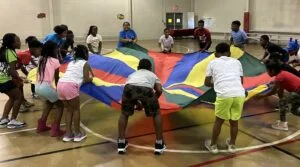
“Popcorn” is always a PE favorite. Using a parachute, mesh balls, and their own muscles, students create a multi-colored frying pan that teaches them color recognition, group cooperation and upper-body strength.

These skills help students learn to work with others and even to motivate each other as they work toward a common goal.

Click Here for a sample lesson plan from this unit

Unit 5: Hoop It Up

This unit uses hoops to teach a wide variety of important skills. For example, in the “Musical Hoops” lesson, students will practice sharing, auditory discrimination, creative imagery, and lower-body strength.

Since hoops can be used in a huge number of ways, our lesson plans use this unit to connect many previous and future units to one another. With the addition of music, for example, students combine important motor skills with creativity and critical thinking.

Click Here for a sample lesson plan from this unit

Unit 6: Ribbons, Scarves, Balloons for Me

This unit expands Unit 5’s hoops theme with a variety of other types of materials. Ribbons and scarves add in another creative element as well as introduce new types of physical abilities (it takes a different set of skills to hold a hoop than it does to hold a ribbon!).

An example lesson here is “Abracadabra” and students learn tossing, catching, and shape recognition—all vital skills for growing children.

Click Here for a sample lesson plan from this unit

Unit 7: Fluffball Fun

Fine motorskills are essential to the physical development of a young child. By using lessons like “Sit and Toss” in this unit, students use the soft and safe fluffballs to learn tossing, hand-eye coordination, visual tracking, and how to cross their body’s midline.

By using such a lightweight item, our lesson plans encourage correct movement skills without danger of heavier objects. This allows students to become adept at specific movements and abilities that build their confidence in a fun way.

Click Here for a sample lesson plan from this unit

Unit 8: Beanbag Bonanza

The next step in locomotor skills is with beanbags. This unit expands on the previous units by combining visual and auditory recognition skills to hand-eye coordination and visual tracking.

An example lesson is “Self-Tossing,” which includes a ton of fun games that help students learn to follow instructions and build their independence by working alone.

Click Here for a sample lesson plan from this unit

Unit 9: Rope Action

Rope lessons are a huge step forward for our young PE students. With lessons like “Introduction to Ropes” students learn behavioral expectations, object manipulation, and pathway recognition.

This helps advance understanding of how objects fit into a space and how they can be used to perform certain tasks. Having these skills at a young age promotes creativity and independent critical thinking in these students.

Click Here for a sample lesson plan from this unit

Unit 10: Have a Ball

This unit introduces ballistic events and quick reaction skills to students. With lessons like “Bounce and Catch,” hand-eye coordination is again practiced, as is bouncing and catching. These two skills are important to add into the student’s ever-growing repertoire of locomotive abilities, along with balancing, agility and upper- and lower-body strength.

Click Here for a sample lesson plan from this unit

Unit 11: Fancy Feet

We wrap-up the early childhood PE lesson plans with a unit that focuses on what we find in our shoes sometimes—our feet! An example lesson here is “Kicking for Distance” and it focuses on balance, auditory discrimination, and visual tracking, as well as kicking.

Once young students have practiced fine motor skills, our lesson plans move into establishing large-scale locomotor skills that children use to interact with the world around them, including one another.

Click Here for a sample lesson plan from this unit

Together, these 11 units form a comprehensive instructional plan that teaches young children exceptionally useful skills from sharing and cooperation to identifying colors and sounds to building strength and coordination.

Teaching PE in Thailand: A SPARKer’s Journey Volunteering Abroad

Friday, February 8th, 2013

By Billy Beltz, SPARK Marketing Director

I’ll admit it, I’m jealous of all the Physical Educators we interact with every day. I’m usually stuck in the SPARK office behind a desk, and they’re out there running around and working directly with the students. I’ve spent time teaching physical activity to youth and I know it’s hard work, and also how rewarding it can be.Teaching PE in Thailand: A SPARKers Journey Volunteering Abroad

So for 2013 I decided to step out of the office and onto the field more often… somehow that ended up being a field 8,000 miles away!

I’m excited to share that in March I’ll be participating in a volunteer project to provide a sports camp and teach physical education to youth in the rural Trat Province of Thailand. I’ll also be donating PE equipment to the schools that they can keep and use year-round, long after I’m gone.

So why is this project important? From my work with SPARK over the last 4+ years I’ve come to realize the amazing benefits of creating an environment where youth are able to engage in active, inclusive and FUN activity. It makes a world of difference- not the least of which is instilling a lifelong love of physical activity. The youth in the communities I’m visiting do not have access to this for much of the year, and that’s why the sports camp is such a big deal to the community there. And I’ll get to share some of SPARK’s amazing activities with the youth and teachers there and hopefully leave them with something they can use after I’m gone!

Additionally (and probably more important) is the ability to donate new PE equipment that will be of lasting benefit to the schools in the area. SPARK’s Executive Director Paul Rosengard has generously agreed to donate PE equipment from out office to be provided to the schools. I’ve checked with the local organization to see what they need and make sure I’m not bringing over anything that wouldn’t be put to good use. They were extremely excited to hear I might provide this, and I can’t wait for the kids to see it in person.

I’ll be volunteering with an organization called uVolunteer. If you’d like to learn more about my project, the organization or to donate to this cause, Click Here.

Wish me luck!!

Billy Beltz

Marketing Director

SPARK

What’s the Best Valentine’s Day Treat? A Healthy Heart!

Tuesday, February 5th, 2013

Valentine’s Day is just around the corner: a time of cards, candy, poems, and hearts adorning every door, window, and wall. While our hearts are often associated with love, they also have one of the most important roles in the human body. Let’s take a closer look at the heart’s function and anatomy.

Heart Shapes and Basics

Contrary to what is depicted in cartoons and popular culture, the heart is shaped like a cone. The apex of the “cone” points down and to the left. It’s hollow and located behind the breastbone, just between the lungs and above the diaphragm. About two-thirds of the heart is located to the left of your body. What’s the Best Valentine’s Day Treat? A Healthy Heart!

In terms of size, the heart is roughly the size of a balled up fist, measuring 2.5 inches deep, 5 inches long, and 3.5 inches wide. On average, a man’s heart weighs about 10.5 ounces, while a woman’s heart weighs 9 ounces.
Proportionally, the heart is less than half a percent of your total body weight, but it is also the body’s most powerful muscle. Such a tiny organ is responsible for pumping blood and oxygen throughout all parts of your body.

Heart Parts

The heart is composed entirely of cardiac muscle that gives it the power to contract and expand and synchronize heart beats. The heart’s wall is divided into three layers:

  • Epicardium: the outer layer that protects the heart from sustaining damage
  • Myocardium: the middle layer composed of muscle
  • Endocardium: the smooth, inner lining of the heart that connects with the inner lining of blood vessels

The inside of the heart is divided into four chambers:

  • Right atrium
  • Right ventricle
  • Left atrium
  • Left ventricle

Blood passes through each chamber via one-way valves, much like the taps on a faucet, which prevent blood from flowing backwards. As each chamber contracts, the valve opens at its exit. At the end of the contraction, the valve closes. The four valves are:

  • Tricuspid valve located at the exit of the right atrium
  • Pulmonary valve at the exit of the right ventricle
  • Mitral valve located at the exit of the left atrium
  • Aortic valve at the exit of the left ventricle

Let It Flow

Blood flow is the name of the game, and the heart is the main player. All your blood enters through two veins located on the right side of the heart: the superior vena cava and the inferior vena cava. The superior vena cava takes blood from the top half of your body, while the inferior vena cava collects blood from the lower half.

From these two veins, your blood enters the right atrium. The right atrium contracts and sends blood through the tricuspid valve to the right ventricle. The right ventricle contracts and sends the blood through the pulmonary valve, through the pulmonary artery, and into the lungs.

Why does blood need to make a pit stop at the lungs? Well, blood that returns from the body is actually pretty lacking in oxygen. In order to get a refill, the blood stops by the lungs before moving on to the left side of the heart.

From the lungs, the blood reenters the heart through the pulmonary veins into the left atrium. It then goes through the mitral valve into the left ventricle and then through the aortic valve into the aorta. The aorta is the main artery of the body. It takes all of the oxygen-rich blood that the heart has pumped and distributes it to all the other organs, tissues, limbs, and body parts.

Where the Heart Gets Its Blood

Like all your other organs, your heart needs blood to get all that oxygen and nutrients. Although all your blood passes through your heart, it doesn’t actually use any of the blood that flows through it. The blood that supplies the heart with oxygen and nutrients is transported through coronary arteries. About 4 to 5 percent of your heart’s total blood output ends up in the coronary arteries.

You have two main coronary arteries, the left main and the right. The left main can be broken up into the left anterior branch and the left circumflex.

The main thing you have to watch out for is coronary artery disease, which is caused by a blockage in the arteries. A partial blockage prevents your heart from getting enough blood, a big problem considering how much your heart exerts itself. This chest pain is described as angina. More severe obstructions can lead to unstable angina. Complete blockage leads to an all-out heart attack. Blockages are composed of plaque and cellular waste products. Regular exercise and a heart-healthy diet are the most effective ways to prevent coronary artery disease.

Love and the Heart

It’s hard to say why love is so often associated with the symbol of the heart. Love has very real physiological effects on the brain, though the heart feels many of the side effects. For example, a racing heart when you see that special someone is caused by an outpouring of adrenaline. Research also shows that many people have lower blood pressure when they are with their romantic partners. Even in newer relationships, the “fresh love” that partners feel for each other can actually shield stress.
So this Valentine’s Day, remember to show some love to your heart. Among all the sweet pink and red decorations, festivities, and treats, our hearts are doing a lot of work!

Diatribe from a Digital Dreamer…

Monday, February 4th, 2013

By Paul Rosengard, Executive Director for SPARK

Almost every morning I have coffee and read the paper.  Someone I’ve never met tosses it onto my driveway when it’s still dark outside.  Are paper people nocturnal?

This, like many habits is a tough one to break – but I’m nearly there.  Soon, I’ll change my subscription from paper to digital (sorry paper people who are reading this in the middle of the night…).  But you’ll have to pry the coffee from my cold, sleepy hands.

When I was a PE teacher, I used to develop lesson plans for my classes, print them onto paper or cards, and read them all day long.  As a coach, this continued after school with practice plans.  Maybe you’re a teacher and doing the same thing? Diatribe from a Digital Dreamer…

Today, technology presents us with options.  Recently, SPARK evolved to offer an all-digital version for every program.  That means lesson plans, assessment tools, content cards, written tests, music, videos — EVERYTHING — can be saved onto a computer and/or downloaded to an iPad/tablet, smartphone or other mobile device.

I’m not teaching anymore but if I were, I’d transition to using an iPad almost exclusively.  Here are just a few reasons why:

  1. Space saving – you can have 10 resource books on a shelf or you can have them in your ibooks section.  More room in your tiny workspace for important things (like that picture of you shaking hands with Lance Armstrong).
  2. Enlarging anything  on the screen – print, diagrams, your photo of Lance Armstrong, etc.
  3. You can check the score of the big game in seconds from your ESPN app – between classes of course…
  4. Connect immediately to an LCD and show videos, use Coaches Eye (app that analyzes movement), teach students how to use an assessment tool, anything you have on your iPad you can project onto a wall.  (BTW no one wants to see that picture of you with Lance Armstrong).
  5. Kids will think you’re cool(er).

We’re in the throes of a digital revolution because for many reasons, paper cannot match up.  Soon, it will be commonplace for teachers and students to receive an updated tablet at the beginning of the school year loaded with their textbooks.  Probably save a lot of backs too.

Will digital change the way teachers teach?  Yes – it absolutely should because a world of possibilities is now available.  Imagine your volleyball exam study guide with hyperlinks to supplemental articles, videos, and photos?  At SPARK, we’re looking forward to the evolution of sight and sound.

We hope you’ll embrace the possibilities and go along for the ride — right after you cancel your newspaper delivery.  I think your paper person will land that dream job and appreciate sleeping later in the morning…

Paul Rosengard

Executive Director

SPARK

Want to get an idea of what’s available on SPARKfamily.org (SPARK’s digital library and home to all e-manuals, videos, assessment tools and other digital resources)? Visit www.sparkpe.org/familysite to learn how to become a member or access or FREE Demo Site!

Diatribe from a Digital Dreamer…